
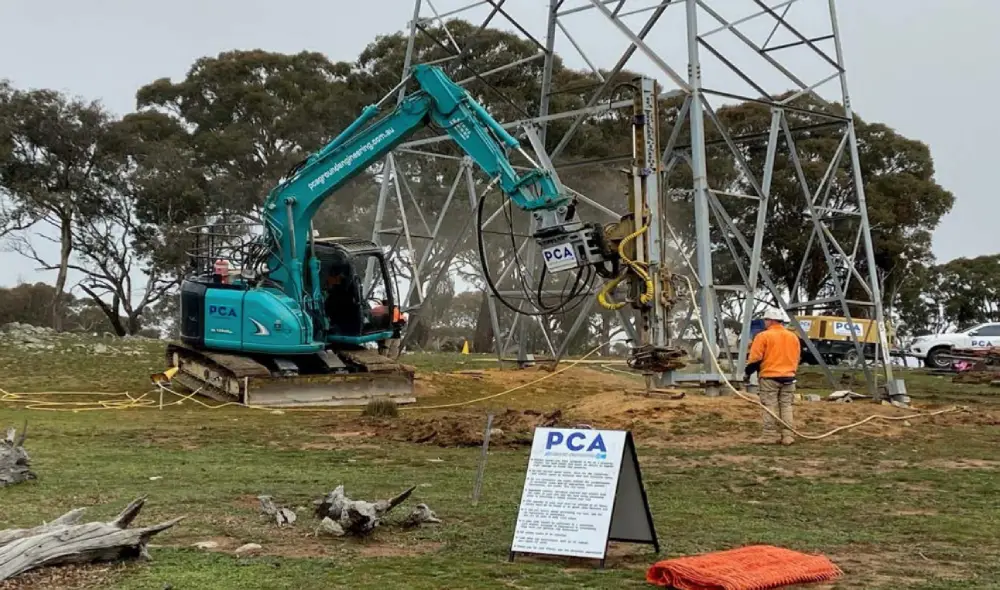
Traditional and Renewable Energy
Traditional Energy
PCA has international patents that support the delivery of critical energy infrastructure, this can extend asset life in substations and transmission corridors through tailored site investigations, foundation design, and risk mitigation strategies, ensuring stability, efficiency, and resilience across a range of terrains and environmental conditions.
Renewable Energy
PCA provide either design and construct or construction only offers to renewable energy projects utilising our expertise across inland and coastal sites ensureing durable foundations that meet evolving energy demands while significantly reducing construction footprint demonstrating the highest levels of environmental responsibility.
Bored Piles for Tower Foundations
Bored piles, also known as drilled shafts, are deep foundation elements constructed by excavating a cylindrical hole and then filling it with reinforced concrete. This method is widely used for transmission towers that require significant load-bearing capacity in deep or variable soils.
Applications and Advantages:
- Suitable for large transmission towers in areas with cohesive or variable soil profiles.
- Customisable in diameter and depth (typically 450 mm to 2,000 mm diameter and up to 30+ metres deep).
- High axial and lateral load capacity.
- Low vibration and noise, ideal near sensitive infrastructure or populated areas.
- Can be constructed through hard layers or soft overburden to reach competent strata.
Bored piles are particularly effective where resistance to overturning and lateral loads from wind, conductor tension, or seismic action is critical. They are often used in conjunction with pile caps to support tower legs in a grid formation.
CFA Piles for Moderate Load Conditions and Fast Installation
Continuous flight auger (CFA) piles are cast-in-place piles formed by drilling with a hollow stem auger, pumping concrete through the stem as the auger is withdrawn, and then inserting reinforcement.
CFA piles offer a fast and efficient alternative to bored piles in moderate soil and load conditions.
Applications and Advantages:
- Ideal for medium-sized towers and substations in urban or peri-urban areas.
- Fast installation with minimal spoil, reducing environmental impact.
- Continuous installation reduces groundwater and collapse risks.
- Suitable for loose to medium dense sands, silts, clays, and gravel.
CFA piles typically range from 300 mm to 900 mm in diameter and up to 25 metres in depth. They are especially valuable when programme efficiency and clean construction practices are a priority.
Micropiles for Challenging Access and Complex Ground Conditions
Micropiles are small-diameter, high-capacity drilled and grouted piles, typically reinforced with steel bars or tubes. Their adaptability and strength make them ideal for upgrading or stabilising existing tower foundations, particularly in restricted-access or complex ground conditions such as steep slopes, floodplains, or remote sites.
PCA’s micropile systems are specifically engineered to increase foundation capacity to accommodate higher wind and structural loads, including those from larger conductors or climate-resilient designs. This allows existing infrastructure to be strengthened efficiently without full foundation replacement.
Applications and Advantages:
• Ideal for tower upgrades, retrofits, and load increases due to modern design or climatic requirements.
• Effective in soft soils, fill, weathered rock, and high groundwater conditions.
• Can be installed at angles to resist uplift, lateral, and overturning forces.
• Low environmental footprint – minimal spoil generation, reduced noise, and small working area.
• Suitable for restricted or sensitive environments, with minimal site disturbance.
• Long design life exceeding 100 years with appropriate corrosion protection.
Micropiles also support seismic retrofitting and are widely used to extend the service life of aging energy infrastructure while meeting modern environmental and structural performance standards.
Integration with Tower Base Systems
At PCA Ground Engineering, our foundation solutions are engineered for seamless integration with all types of tower base systems, ensuring strength, stability, and long-term performance. We carry out detailed design checks of existing structures to assess their condition, load capacity, and interaction with new foundations – guaranteeing safe and efficient performance under all loading conditions.
Our three piling systems – bored piles, CFA piles, and micropiles — can be configured with reinforced concrete pile caps, steel grillages, or patented bracket systems for precise interface with tower bases.
For retrofit projects, micropiles are ideal as they can be installed beside or through existing foundations without removal, reducing outages, noise, and environmental impact.
For new installations, bored or CFA piles provide a cost-effective and robust foundation option where ground conditions and access allow. Micropiles can be adopted where ground conditions or access is poor or where concrete supply is limited.
System selection is guided by geotechnical data, structural design requirements, and constructability analysis, ensuring every solution is efficient, compliant, and fully integrated.
Design and Compliance
At PCA Ground Engineering, we deliver foundation systems that meet the highest standards of safety, performance, and regulatory compliance. Every design is developed in accordance with both Australian and leading international standards, ensuring reliability and confidence for our clients.
Our design framework aligns with:
• AS 2159 – Piling: Design and Installation
• AS/NZS 7000 – Overhead Line Design: Transmission Lines
• AS 5100 – Bridge Design (including structural–geotechnical interaction)
• FHWA Guidelines – Federal Highway Administration (U.S.) standards for deep foundations and ground improvement
• EN 14199 – Execution of Special Geotechnical Work: Micropiles
• Relevant Utility and Asset Owner Specifications
PCA offers full design certification services and can provide third-party reviewed designs where independent verification is required. This ensures transparency, technical integrity, and compliance with project-specific and statutory requirements.
Using advanced finite element modelling, pile load testing, and real-time installation monitoring, PCA validates design performance under real-world conditions. By integrating Australian, FHWA, and European (EN 14199) standards, we deliver foundation solutions that are safe, efficient, and globally benchmarked for quality and reliability.
Why Choose Us?
PCA Ground Engineering are trusted experts in providing safe, sustainable, and innovative foundation and ground improvement solutions for transmission line and energy infrastructure projects. Our extensive experience across Australia’s diverse geotechnical environments ensures every project is delivered efficiently, safely, and to the highest standard.
We understand the unique challenges of energy and transmission projects—from remote access and variable soil conditions to demanding schedules and environmental expectations. Our fully integrated services are designed to optimise performance, reduce costs, and minimise risk at every stage.
Our Key Advantages:
• Comprehensive Geotechnical and Site Feasibility Studies – Early analysis to assess ground conditions and inform design decisions.
• Foundation Design Optimisation – Custom-engineered solutions for cost efficiency and long-term stability.
• Specialist Piling and Ground Improvement Equipment – Designed for productivity in restricted or challenging conditions.
• Low Environmental Footprint – Sustainable techniques that reduce waste, noise, and emissions.
• In-House Design Capability – Seamless integration of design and construction for efficient project delivery.
• ISO Certified for Safety, Quality, and Environmental Management – Assurance that every project meets the highest international standards.
With a reputation built on innovation, safety, and quality, we are the trusted partner for utility providers, EPC contractors, and transmission authorities across Australia and internationally.